Thyristor


Thyristor Family-Types of Thyristors
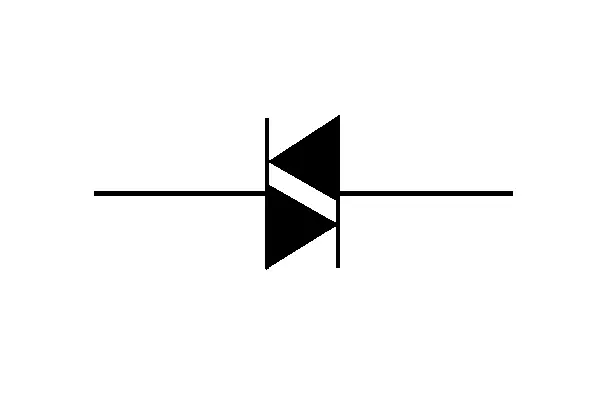
- Diac Circuit Symbol
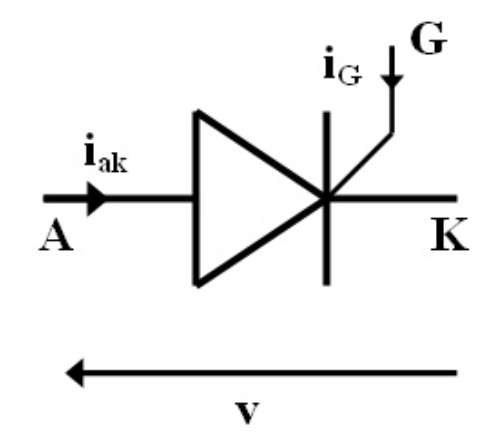
- Thyristor Circuit Symbol
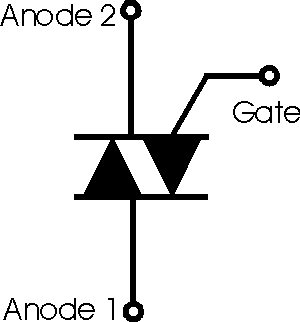
- Triac Symbol
- Ujt Symbol

The P-N-P-N devices with zero, one or two gates constitute the basic thyristor. But today the thyristor family includes other similar multilayer devices also. The complete list of thyristor family members include diac(bidirectional diode thyristor), triac (bidirectional triode thyristor), SCR (silicon controlled rectifier), Shockley diode, SCS (silicon controlled switch), SBS (silicon bilateral switch), SUS (silicon unilateral switch) also known as complementary SCR or CSCR, LASCR (light activated SCR), LAS (light activated switch) and LASCS (light activated SCS).
The most important member of the thyristor family is the silicon controlled rectifier (SCR).SCR is a four layer (P-N-P-N), three junction semiconductor device with three terminals, namely, the anode, the cathode and the gate. It is a unilateral device and conduction takes place from anode to cathode under proper bias conditions (forward bias).
Diacs and triacs are bidirectional devices. The diac is a two-terminal, three layer device and is commonly used for triggering triacs. The triac is a 3-terminal semiconductor device and may be considered equivalent to two SCRs connected in antiparallel. Shockley diode is a two terminal reverse blocking diode thyristor having no gate. SCS (silicon controlled switch) is similar to SCR except that it has two gates and can be turned-on or off by either gate. SUS (silicon unilateral switch) has gate on the anode side and can be employed as a programmable unijunction transistor (PUJT). SBS (silicon bilateral switch) is a device consisting of two identical SUS structures arranged in antiparallel but having only one gate, that is used only for external synchronization or for proper biasing. LASCR is the light-activated SCR which is turned on by photon bombardment.
UJT (unijunction transistor), unlike a bipolar transistor has only one junction, and like other conventional transistors, it processes the transistor action and operates like a switch. The characteristics of UJT are similar to those of a SUS. Its construction is, however, different and it does not belong to thyristor family.
.

Walang komento:
Mag-post ng isang Komento